
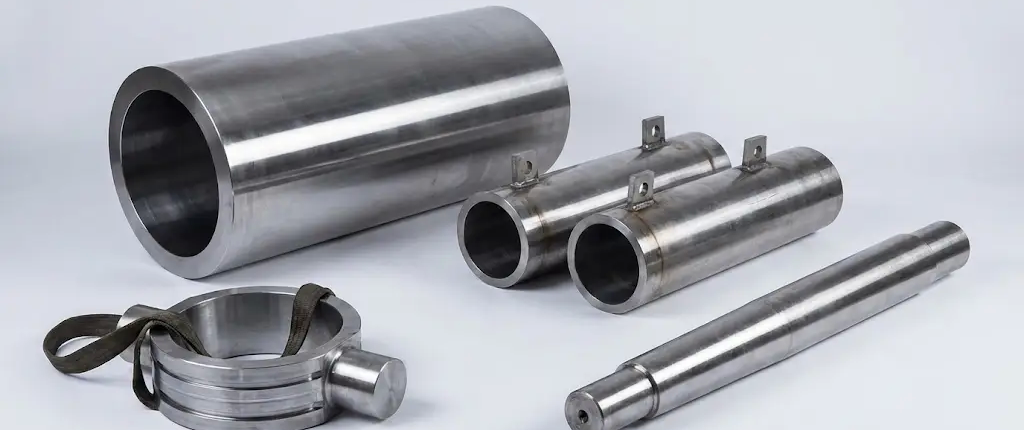
Hydraulic cylinders convert fluid pressure into mechanical force, powering critical equipment from construction excavators to marine platform control systems. The quality of each component directly determines the reliability and service life of the entire cylinder, while manufacturing technologies must achieve micron-level precision when working with materials of varying hardness. Modern contract manufacturing enables customers to receive component kits or complete cylinders manufactured to drawings with guaranteed compliance to international standards ISO 6020 and ISO 6022.
Hydraulic Cylinder Architecture: Component Functions and Requirements
A hydraulic cylinder consists of six main component groups, each performing specific functions and imposing particular requirements on materials and manufacturing precision.
The cylinder barrel (tube) is the load-bearing element within which the piston travels. The barrel’s inner surface functions as both a guiding and sealing surface, requiring strict specifications: surface roughness Ra 0.2–0.6 µm, diameter tolerance to H8/H9 grade, and straightness not exceeding 1 mm per meter of length. These parameters are achieved through honing—a finishing abrasive process that creates a characteristic cross-hatch pattern of micro-grooves that retain the oil film.
The piston rod transmits force from the piston to the actuating mechanism and is the most heavily loaded cylinder element. Rod diameters range from 6 to 900 mm, with lengths reaching 12–18 meters. The rod surface must ensure sealing integrity during dynamic contact with seals, requiring surface roughness of Ra 0.1–0.4 µm and diameter tolerance of f7 or g6 per ISO. Chrome plating 20–50 µm thick protects the rod from corrosion and wear.
The piston generates pressure and converts hydraulic energy into mechanical motion. Manufacturing precision is critical for sealing: concentricity between bore and outer diameter must not exceed 0.01–0.02 mm, and face perpendicularity to axis must be within 0.04 mm per 100 mm diameter. Typical piston-to-barrel fits are H8/f7 or H9/g8, providing optimal clearance for seal operation.
End caps and glands provide cylinder sealing and rod guidance. The front cap (gland) houses rod seals, wiper, and guide bushing. Cap mounting methods include threaded connection, tie-rod assembly, welding, and bolted flange connection—selection depends on operating pressure and service conditions.
Guide bushings and wear rings absorb radial loads, preventing metal-to-metal contact between rod and gland. Modern guides are manufactured from PTFE composites, reinforced polyamide, or traditional bronze, with cross-section tolerance of ±0.025 mm.
Sealing elements include piston seals, rod seals, buffer rings (for pressure spike dampening), wipers, and back-up rings that prevent primary seal extrusion.
Machining Technologies: From Blank to Finished Component
Manufacturing hydraulic cylinder components requires a complex of technological operations ensuring high precision and surface quality.
CNC turning is used for manufacturing rods, pistons, caps, and glands. Operations include rough and finish machining of external and internal surfaces, thread cutting, face turning, and forming seat surfaces. Modern turning centers achieve positioning accuracy to 0.005 mm.
Milling creates complex profiles, oil grooves, keyways, mounting holes, and assembly surfaces. Machining centers enable complete part production in a single setup.
Honing is the key operation in barrel manufacturing. The process provides geometry correction (ovality, taper), creates cross-hatch pattern at 40°–80° angles, and achieves Ra 0.2–0.6 µm roughness. An alternative method—skiving and roller burnishing (SRB)—plastically deforms the surface, creating a cold-hardened layer with enhanced wear resistance. Processing range: diameters 50–750 mm, lengths to 16 meters.
Grinding is applied for rod processing (cylindrical and centerless grinding), rough barrel preparation before honing (internal grinding), and finish machining of seat surfaces.
Rod chrome plating is an electrochemical process depositing hard chrome that provides corrosion and wear resistance. Standard coating thickness is 20–30 µm, chrome hardness 850–1150 HV (66–72 HRC). Marine applications use duplex coating with 125 µm nickel underlayer and 125 µm chrome layer. Coating quality is verified by salt spray testing per ASTM B-117 (minimum 48 hours).
Heat treatment of rods includes quenching and tempering to 229–285 HB hardness and induction surface hardening to 45–60 HRC at 2–7 mm depth. Induction hardening is critical for rods operating under impact loads—it protects the chrome layer from chipping during quarry and construction site operation.
Materials: Selection for Operating Conditions
Material selection is determined by working loads, pressure, temperature, and environmental aggressiveness.
- Component
- Piston Rods
- Piston Rods
- Piston Rods
- Barrels
- Barrels
- Guide Bushings
- Guide Bushings
- Material
- C45, CK45, SAE1045
- 40Cr, 42CrMo4
- AISI 304, AISI 316
- ST52.3/E355
- E410, E470
- CuSn12
- CuAl10Fe4Ni4
- Properties
- ≥600 N/mm²
- 900–1100 MPa
- Corrosion resistant
- ≥520 MPa tensile, ≥355 MPa yield
- Enhanced strength
- 480–520 MPa, up to 400°C
- Nickel-aluminum bronze
- Application
- Standard applications
- Higher loads
- Aggressive environments
- Standard cylinders
- High-load cylinders
- Universal application
- Seawater service
Seals are manufactured from polyurethane (high wear resistance, range -50…+120°C), nitrile rubber NBR (versatility, -30…+100°C), fluoroelastomer FKM/Viton (chemical resistance, to +204°C), and PTFE (low friction, -200…+260°C, pressure to 400 bar).
Industry Applications and Special Requirements
Standards and Quality Control
Hydraulic cylinder manufacturing is governed by international and national standards. ISO 6020-1 and ISO 6020-2 establish dimensions for 16 MPa (160 bar) cylinders, ISO 6022 for 25 MPa (250 bar) with piston diameters 50–320 mm. ISO 3320 defines the metric diameter series, ISO 4395 specifies rod thread types.
Quality control includes mandatory testing: strength at 1.5× rated pressure, external and internal leak tightness, breakaway pressure, and function at no-load and under load. All cylinders undergo preliminary run-in. For critical applications, 100% bench testing of each unit is performed with technical documentation.
Contract Component Manufacturing
The modern approach to hydraulic cylinder production enables ordering complete units, individual components, or assembly kits for customer assembly. Customers can receive: honed barrels to specified dimensions, chrome-plated rods with required tolerances and coating, machined pistons, caps and glands, and seal and guide kits.
The manufacturer provides technical support during development, drawing optimization for manufacturing capabilities, quality control per PPAP standards or customer requirements, and volume flexibility—from prototypes to series production.
Eurobalt Engineering Capabilities
Eurobalt Engineering OÜ is a European manufacturer of precision metal components with full-cycle machining capabilities. We manufacture hydraulic cylinder components to customer drawings: chrome-plated and heat-treated rods, honed barrels, pistons, caps, glands, and assembly kits.
Our advantages:
- Modern CNC machine park
- Barrel honing to 500 mm diameter
- Rod chrome plating with coating thickness control
- Heat treatment including induction hardening
- Manufacturing to ISO 6020, ISO 6022 standards
- Flexible volumes: from single units to series


