
Tungsten Carbide Grade Selection: Cobalt Content, Grain Size and ISO K-Class
A practical engineering guide for selecting the right hardmetal grade for wear, impact and corrosion-driven applications.
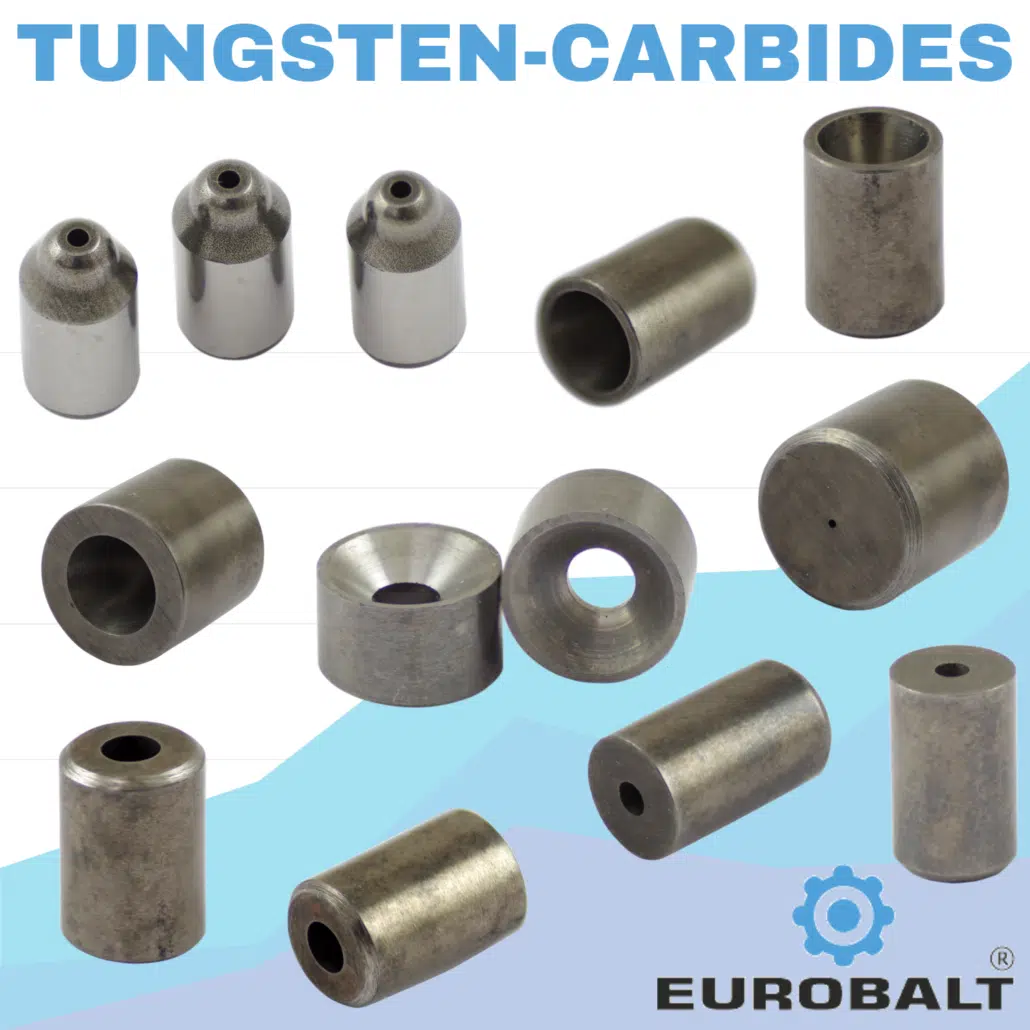
When two cemented carbide components look identical on a drawing, their service life can still differ by a factor of three to five – purely because of the underlying grade. Hardmetal is not a single material. It is a family of WC-Co composites whose mechanical behaviour is engineered through three independent levers: cobalt content, tungsten carbide grain size, and carbide additives. Choosing the wrong combination is the single most common reason for premature failure of carbide bushings, nozzles, dies and drilling components.
This article explains how Eurobalt approaches grade selection within the ISO 513 K-class system, the framework used across European hardmetal manufacturing, and how to translate the conditions of your application into a specific grade recommendation.
Why grade selection matters
A WC-Co hardmetal sits on a Pareto front between two properties that pull in opposite directions: hardness (which drives abrasion resistance) and transverse rupture strength (which governs resistance to impact and cyclic load). You cannot maximise both. Every grade is a deliberate compromise placed somewhere on this curve.
In practice this means:
- A nozzle running pure abrasive water flow benefits from a hard, fine-grained grade with low cobalt – but the same grade will chip catastrophically if used as a percussion drill insert.
- A bushing in a hammer drill needs a tougher, higher-cobalt grade – but if the same grade ends up in a precision flow restrictor, it will erode within hours.
The selection process is therefore not “pick the hardest material available” – it is matching the position on the hardness-toughness curve to the dominant failure mechanism in service.
The three levers of hardmetal performance
1. Cobalt content (binder phase)
Cobalt forms the continuous metallic network that binds the WC grains. It is the primary lever for toughness.
| Co content | Behaviour |
|---|---|
| 3-6 % | Maximum hardness, minimum toughness – pure abrasion only |
| 6-10 % | Balanced wear and moderate impact resistance |
| 10-15 % | Significantly improved impact toughness, reduced hardness |
| 15-25 % | Heavy impact and forming applications, e.g. cold-heading dies |
Each percentage point of cobalt typically reduces hardness by ~0.5 HRA and increases TRS by 50-100 MPa.
2. Tungsten carbide grain size
Grain size is classified per ISO 4499 and is just as influential as cobalt content. For the same Co level, a finer microstructure produces higher hardness and edge retention; a coarser microstructure absorbs more energy before fracture.
| Class | Mean WC grain size | Typical effect |
|---|---|---|
| Ultra-fine (UF) | < 0.5 μm | Highest hardness, sharp edges, sensitive to chipping |
| Fine (F) | 0.5-1.4 μm | High wear resistance, fine surface finish |
| Medium (M) | 1.4-3.4 μm | General-purpose wear and structural parts |
| Coarse (C) | 3.4-5.0 μm | Improved thermal shock and impact resistance |
| Extra-coarse (XC) | > 5.0 μm | Heavy percussion, rock drilling |
3. Carbide additives
Small additions of secondary carbides modify specific properties without changing the WC-Co backbone:
- TaC, NbC – improve high-temperature hardness and reduce edge deformation.
- Cr₃C₂ – acts as a grain-growth inhibitor during sintering and improves corrosion resistance.
- TiC – increases hot hardness and reduces affinity with ferrous metals (relevant for cutting tools more than for wear parts).
For most wear and structural applications produced at Eurobalt, additives are kept minimal to preserve the WC-Co toughness profile.
ISO 513 K-class grade map
The ISO 513 K-classification covers hardmetals intended for machining cast iron, non-ferrous metals, and non-metallic materials, and by extension is the standard reference for wear parts and structural carbide components. Lower K numbers indicate harder, more wear-resistant grades; higher K numbers indicate tougher grades for impact and forming.
The table below shows the typical property envelope across the K-range produced at Eurobalt:
| ISO 513 class | Co content | Grain size | Hardness (HRA) | TRS (MPa) | Density (g/cm³) | Typical applications |
|---|---|---|---|---|---|---|
| K01-K10 | 3-6 % | UF / F | 91.5-93.0 | 1500-1800 | 14.9-15.1 | Precision wear inserts, water jet orifices, fine flow nozzles, light-duty seal rings |
| K20 | 6-8 % | F / M | 90.0-91.5 | 1800-2100 | 14.7-14.9 | Bushings, plungers, valve seats, abrasion-driven sleeves |
| K30 | 8-10 % | M | 88.5-90.0 | 2000-2300 | 14.4-14.7 | Oil & gas chokes, downhole bushings, magnetised functional parts, general industrial wear |
| K40 | 10-15 % | M / C | 86.5-88.5 | 2200-2500 | 13.9-14.4 | Rolling rollers, percussion drill inserts, components under cyclic impact |
| K50 | 15-25 % | C / XC | 82.0-86.5 | 2400-2800 | 13.0-13.9 | Cold-heading dies, mining picks, heavy stamping tools |
Values are typical envelopes and are confirmed for each batch through the in-house quality programme described below.
The hardness-toughness trade-off
Every K-class grade occupies a specific position on the hardness-toughness curve. Moving from K01 to K50, hardness decreases from ~93 to ~83 HRA while transverse rupture strength increases from ~1500 to ~2800 MPa. A given application defines a target zone on this curve – the selection problem is geometrical, not categorical.

Selecting a grade by application scenario
Scenario A – Pure abrasive wear, low impact
Examples: water jet focusing tubes, sandblasting nozzles, slurry orifices, light-duty seal rings.
The dominant failure mechanism is particle erosion. Hardness and fine grain matter most; toughness is secondary because there is no shock loading.
Recommended grade: K01-K10, fine or ultra-fine grain, 4-6 % Co.
Scenario B – Abrasion combined with cyclic or pressure loading
Examples: oil & gas choke pipes, downhole bushings, valve cores in high-pressure systems, hydraulic wear sleeves.
The component sees abrasive media but also cyclic mechanical or pressure loading. Pure K10 grades will crack under fatigue; K40+ grades will erode too quickly.
Recommended grade: K20-K30, medium grain, 7-9 % Co. This is the workhorse range for upstream oil & gas and high-pressure industrial wear parts.
Scenario C – Impact-dominated wear
Examples: rolling rollers, percussion drill bits, hammer-mounted tooling, crushing inserts.
The component must absorb repeated shock without spalling. Hardness is sacrificed for fracture toughness.
Recommended grade: K40, medium-to-coarse grain, 10-15 % Co. Where the impact energy is exceptional – heavy mining picks, cold-heading dies – K50 with 15-25 % Co is the appropriate choice.
Scenario D – Corrosive or chemically aggressive environments
Examples: components contacting acidic process fluids, brine, or chloride-containing media.
Standard WC-Co loses cobalt by leaching in acidic environments. Two strategies apply:
- Add Cr₃C₂ (typically 0.5-1 %) to passivate the binder and slow down corrosion.
- For aggressive media, switch to a WC-Ni or WC-Ni-Cr binder system, which trades a small amount of toughness for substantially better chemical resistance.
A short discussion of the operating environment at the quotation stage allows Eurobalt’s metallurgy team to propose the right binder modification rather than relying on a default WC-Co grade.
Verifying the delivered grade
A grade specification is only meaningful if it can be verified on the finished part. Every Eurobalt batch is qualified against the property envelope of its declared K-class through:
- Hardness testing per ISO 3878 – Vickers HV30 or Rockwell HRA, with sample-size statistics for production batches.
- Transverse rupture strength per ISO 3327 – destructive testing on representative bend bars from the same sintering cycle.
- Density measurement – direct cross-check against the theoretical density for the declared Co content; deviations indicate residual porosity.
- Porosity rating per ISO 4505 – metallographic comparison against standard A/B/C porosity classes.
- Microstructural analysis per ISO 4499 – mean grain size and grain size distribution measured optically.
- Magnetic methods – coercive force (Hc) and magnetic saturation (σ) provide non-destructive, batch-level confirmation of cobalt content and effective grain size. This is particularly useful when 100 % of a batch must be screened.
For functional components – such as magnetised K30 bushings produced under Eurobalt’s ISO 2768-mK programme – magnetic verification is performed on every part rather than on a sample basis.

What to send for a grade recommendation
Eurobalt’s engineering team can propose a specific grade once the following information is available:
- Drawing or sketch with critical dimensions and surface finish requirements.
- Operating environment – temperature range, media (with abrasive type and particle size if known), chemical aggressiveness.
- Loading profile – static, cyclic, or impact; magnitude and frequency.
- Required surface finish – Ra on functional surfaces; this drives the grinding strategy and indirectly the maximum allowable grain size.
- Batch volume and tolerance class – for selecting between as-sintered, lightly ground, or fully ground delivery.
- Any mating components – particularly relevant for press-fit, brazed, or shrink-fit assemblies.
With this information, a grade can usually be confirmed within one engineering review, and a quotation can be issued without further iteration.
In-house manufacturing capabilities
Eurobalt manufactures across the full ISO 513 K-class range, with the complete production cycle controlled in-house:
- WC and Co powder blending with controlled binder distribution
- Cold and isostatic pressing of green compacts
- Vacuum and controlled-atmosphere sintering at 1350–1450 °C
- Diamond grinding of functional surfaces to Ra 0.4 μm or better
- Full dimensional, mechanical, microstructural and magnetic inspection
- Laser marking for traceability
Component size ranges from 0.001 kg (small precision inserts) to 300 kg (large rollers and structural parts), with as-sintered tolerances of ±0.15 mm and ground tolerances of ±0.01 mm.
Standards reference
| Standard | Scope |
|---|---|
| ISO 513 | Classification of hardmetals by application (K/M/P/N/S/H classes) |
| ISO 4499 | WC grain size classification and measurement |
| ISO 3878 | Vickers hardness testing of hardmetals |
| ISO 3327 | Transverse rupture strength – bend bar test |
| ISO 4505 | Metallographic porosity rating (A/B/C classes) |
| ISO 2768-mK | General dimensional tolerances – medium tolerance class |


