
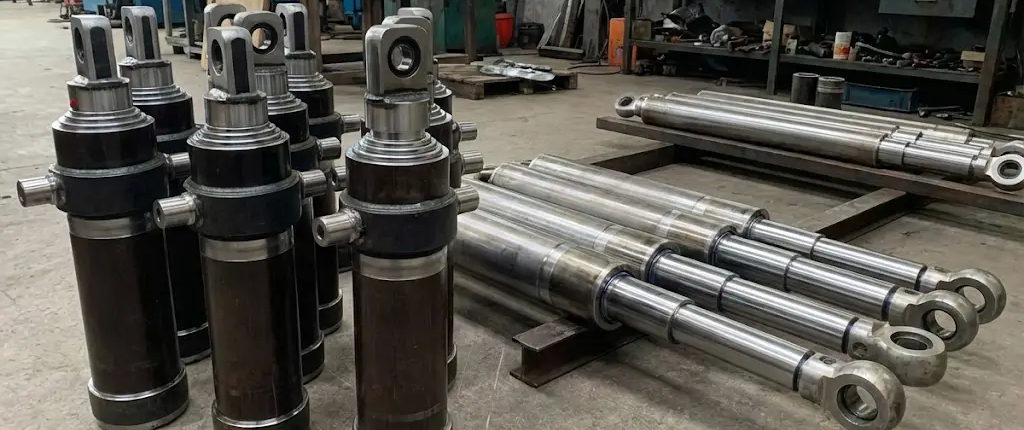
Telescopic hydraulic cylinders solve a fundamental engineering challenge — delivering a long stroke while maintaining minimal retracted length. Unlike standard cylinders, where collapsed length roughly equals the stroke, telescopic designs compress to just 20–40% of full stroke, with pneumatic versions reaching as low as 15%. This characteristic makes them indispensable wherever space is limited: from dump truck bodies and crane booms to ship hatches and press equipment.
Operating Principle and Design Solutions
A telescopic cylinder operates on the principle of nested sections, where each outer sleeve serves as the housing for the next, smaller-diameter stage. When pressure is applied, the stage with the largest effective area extends first, providing maximum force at the beginning of the stroke. As smaller stages extend, speed increases while force decreases.
Single-acting cylinders — the most common type — extend under hydraulic pressure and retract by gravity or external load. Typical application: raising a dump truck body, where cargo weight ensures reliable retraction. Double-acting designs provide hydraulic control in both directions but require a complex internal passage system to deliver fluid to intermediate stages. They are used where retraction speed control is needed: refuse trucks, excavators, roll-on/off systems.
The practical design limit is 6 stages (up to 9 for pneumatic), with working pressure typically limited to 200–250 bar due to the risk of sleeve “ballooning.” For comparison: standard piston cylinders operate at 320–350 bar and above.
Materials: From Tube to Seal
Sleeves and housings are manufactured from cold-drawn precision tubing. The most common steel is ST52.3/E355 (DIN 2391, EN 10305-1) with tensile strength ≥490 MPa and yield strength ≥355 MPa. For demanding conditions, high-strength 27SiMn (≥980 MPa) or alloyed 42CrMo/SAE 4140 (≥1080 MPa) are used. In marine and chemical environments, stainless steels 304 and 316L are employed.
- Steel Grade
- ST52.3/E355
- 27SiMn
- SAE 4140/42CrMo
- AISI 316L
- Tensile Strength
- ≥490 MPa
- ≥980 MPa
- ≥1080 MPa
- ~480 MPa
- Application Area
- Standard cylinders
- Mining equipment, presses
- High pressure, impact loads
- Marine environment, chemical industry
Rods require high surface hardness and corrosion resistance. The standard solution is 1045 or 42CrMo4V steel with induction hardening to HRC 58–60 followed by hard chrome plating. Surface hardness after chrome plating reaches 800–1000 HV, with roughness of Ra 0.1–0.3 μm.
Sealing materials are selected based on working medium and temperature range. Polyurethane (PU) is optimal for mobile equipment at temperatures −30…+80°C due to high wear resistance. NBR (nitrile rubber) works up to +100°C in standard oils. FKM/Viton withstands up to +200°C and aggressive media. PTFE with elastomer energizer provides minimum friction and chemical inertness but requires an additional sealing element.
Precision Machining Operations
Internal honing of tubes determines the service life of seals and the cylinder as a whole. Optimal roughness is Ra 0.2–0.4 μm with characteristic cross-hatch pattern at 30–45° angle. Internal diameter tolerance is H8 for standard and H7 for high-precision cylinders. The alternative SRB process (skiving + roller burnishing) achieves Ra <0.2 μm while simultaneously strengthening the surface through work hardening.
Modern honing equipment processes tubes with diameters of 18–1000 mm and lengths up to 14–20 meters with accuracy of ±5 μm and straightness of 1–1.2 mm/m.
Rod processing includes grinding to f7 tolerance, chrome plating, and finish polishing. Concentricity between rod and piston is critical — tolerance ≤0.01–0.02 mm. Chrome layer thickness is 15–25 μm — sufficient for wear resistance while minimizing internal stresses in the coating.
Welding of cylinder elements (end caps, ports, mounts) is performed using MIG/MAG or TIG methods with mandatory non-destructive testing of welds: ultrasonic, radiographic, or magnetic particle inspection depending on the criticality of the structure.
Wide Range of Applications
Protective Coatings: From Classic to Innovation
Standards and Quality Control
The regulatory framework is based on ISO standards: ISO 6020-1/2 (160 bar cylinders), ISO 6022 (250 bar), ISO 4413 (general requirements for hydraulic systems). European manufacturers follow DIN 24333/24336, American — ASTM A519 for tubing and SAE for hydraulic components.
Pressure testing is performed at 1.1–1.5× working pressure with a minimum 10-minute hold. Acceptance criteria: absence of external leaks, deformations, and sleeve “ballooning”; pressure gauge stability for at least 30 seconds.
Cyclic endurance testing varies from thousands of cycles for heavy press cylinders (low-cycle fatigue) to millions for aircraft actuators.
Hydraulic fluid cleanliness per ISO 4406 is critical for longevity. Telescopic cylinders operate with oil of classes 18/16/13 or cleaner; systems with servo valves require 16/14/11.
Size Range: From Small to Giant
Small cylinders (diameter 40–110 mm, 2–3 stages) with strokes up to 2500 mm and forces up to 100 kN are used in agricultural equipment and light trailers.
Medium cylinders are the industry workhorses. Diameters 139–210 mm, up to 5 stages, stroke up to 8.5 m, force 90–265 kN at 170 bar. Cylinders with 226 mm diameter lift bodies weighing 100+ tons.
Large-bore cylinders for presses, shipbuilding, and drilling rigs reach diameters of 500–1000+ mm and strokes of 30 meters. Manufacturers produce cylinders for presses with forces of 10,000 tons and more.
The diameter ratio of adjacent stages typically follows a 0.75-inch (19 mm) step, providing an area ratio of 3:1–10:1. During retraction of double-acting cylinders, this creates a pressure intensification risk: at a 7:1 ratio, return line pressure can increase 7-fold, requiring pressure relief valves.
Eurobalt Engineering Capabilities
Telescopic hydraulic cylinders are technologically complex products where every component affects the reliability and service life of the entire system. The quality of honed tubes determines seal performance, rod machining precision — sealing integrity, coating selection — corrosion resistance under specific operating conditions.
Eurobalt Engineering specializes in precision hydraulic system components:
- Honed tubes with roughness Ra ≤0.4 μm and H7/H8 tolerances
- Rods with various coatings: chrome plating, QPQ, thermal spraying
- Guide elements and accessories
- Complete mechanical processing cycle
Integration of multiple processing stages with a single supplier reduces lead times and ensures end-to-end quality control — from metal certificates to acceptance testing of finished components.


