
Hydraulic Cylinders for Forestry Machinery in the Nordic Countries
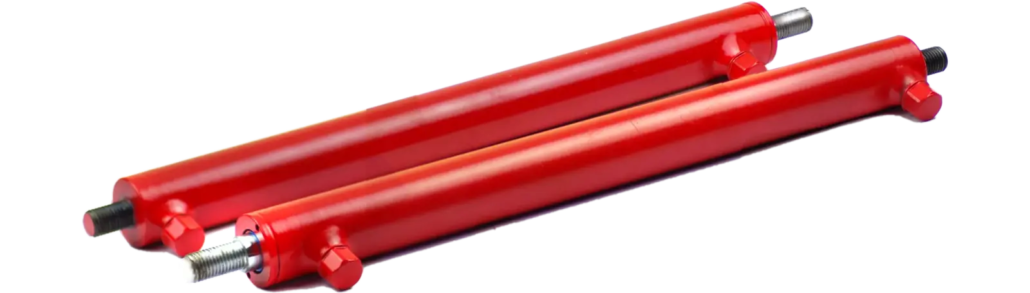
Eurobalt manufactures hydraulic cylinders for harvesters, forwarders and other forestry machines working in Sweden, Finland and Norway.
The Nordic Forestry Market
Sweden, Finland and Norway run some of the most mechanised forestry in the world. Cut-to-length harvesters and forwarders work two shifts through a short, wet season, and a network of local workshops keeps the fleet moving. Every one of those machines is built around hydraulics. A harvester head alone can carry ten or more cylinders and motors. Add a forwarder’s crane, bunk and stabiliser legs, and the count goes up again. Demand for cylinders in the diameters and strokes the local fleet actually runs has always been steady here.
For decades, part of that demand was served by Tubex AB, building single-acting, double-acting, telescopic and custom hydraulic cylinders, including telescopic units rated to 210 bar working pressure. For buyers who previously relied on Tubex for flexible, small-batch and custom cylinder solutions, Eurobalt offers a capable independent manufacturing alternative.
At Eurobalt we build our own hydraulic cylinders, to our own process. For years we have supplied cylinders for forestry, agricultural and construction machinery. For a fleet owner or an OEM in Sweden, Finland or Norway that means cylinders made to drawing or to sample, in the batch size the order actually needs, with the northern climate written into the specification from the start.
Why an Ordinary Cylinder Does Not Survive in the Forest
A cylinder on a harvester head or a forwarder crane never sees a clean workshop. It works pressed against bark, resin, frozen mud and stone dust, cycling thousands of times a shift.
- Abrasive dirt and grit grind into the rod at every stroke, and the timber itself drives them deeper
- Resin and bark residue bake onto exposed metal, then attack the seals chemically over a season
- Shock and side loading arrive constantly. A grapple slams shut on an off-centre log. A boom strikes a stump. A stabiliser leg lands on a rock
- Daily high-pressure wash-down drives water and grit straight at the rod seals and wiper rings
- Through the winter half of the season that same water refreezes overnight, in exposed joints and on the rod surface
- Maintenance windows are short. Cut-to-length harvesting runs almost continuously, and a machine stands still only as long as an urgent repair takes
Most industrial hydraulics never face that combination. Agricultural cylinders come closest, but they deal with dust and seasonal storage; forestry adds constant shock loading, resin and cold to the same duty cycle. A cylinder specified for a factory press, or for a farm loader, will lose its seals and its rod surface here long before the machine itself is worn out.
What Goes Into the Cylinder for Service Life
Rod, coating, seals and welding decide whether a forestry duty cycle adds years to a cylinder or takes them away.
| What we specify | Why it matters in forestry duty |
|---|---|
| Induction-hardened piston rod, tube honed to H8, rod ground to f7 | Correct fits and a hard, dimensionally stable rod stand up to constant abrasive contact with bark and grit |
| Hard chrome plating, or duplex nickel + hard chrome, up to 80 μm | Hard chrome on its own (800–1000 HV, friction coefficient 0.12–0.16) resists wear well, but its microcrack network limits neutral salt-spray life to roughly 40–96 hours (ISO 9227). A nickel underlayer closes those cracks and raises corrosion resistance substantially, which counts on a machine washed with salted water through the de-icing season |
| Seals from Hallite and Trelleborg, matched to duty and temperature | Rod seals and wipers take the grit first, and brand compounds hold their profile under repeated shock loading where generic seals extrude |
| Fully automatic welding on tube-to-end and port welds | A consistent, fully penetrated seam counts for most on a cylinder that takes side loading as well as axial force |
| 100% pressure and leak testing before dispatch | A cylinder that fails on a harvester head costs a full shift of downtime, not just the price of a part |
Where wear resistance has to go further than hard chrome allows, we also offer HVOF thermal-sprayed coatings: tungsten carbide, WC-10Co-4Cr, 1100–1400 HV. HVOF runs 4 to 100 times more wear-resistant than hard chrome, with porosity under 1%, and over a nickel underlayer it reaches around 720 hours of neutral salt-spray resistance (ISO 9227). It also avoids hexavalent chromium (Cr⁶⁺), which hard chrome plating uses and which REACH and RoHS now restrict.
Northern and Arctic Climate Execution
Standard hydraulic components are specified around room temperature and moderate climates. A cylinder that will winter in Norrland, Lapland or northern Norway needs the cold end of its specification checked rather than assumed.
Seals. Elastomer choice sets the low-temperature floor for the whole cylinder.
- Polyurethane, our default for mobile equipment, is rated for continuous service at −30…+80 °C and resists abrasion well, which suits both the cold and the grit
- Standard NBR handles up to +100 °C in typical mineral oils. On the cold side, general-purpose NBR grades are usually rated to about −34 °C, and low-temperature NBR compounds reach roughly −55 °C (Parker O-Ring Handbook, ORD 5700)
- HNBR compounds stay flexible to around −40 °C and beat standard NBR on heat, ozone and chemical resistance, which helps where cold meets resin and hydraulic fluid
- FKM (Viton) belongs to +200 °C service and aggressive fluids, not to cold work. Standard FKM stiffens from around −20 °C, so we reach for it in a northern build only when the application specifically needs its chemical resistance
- PTFE with an elastomeric energiser gives minimal friction and chemical inertness across a wide range, though it needs an additional sealing element
For a genuinely northern or arctic build we choose seal compounds and hydraulic fluid against the coldest point of the machine’s real duty, not the seasonal average.
Hydraulic fluid. A cylinder is only as cold-capable as the oil moving through it. Low-viscosity grades (ISO VG 32 and below) with a high viscosity index and a low pour point stay fluid at cold start-up, where a thicker oil would starve the pump and strain the seals before the system warms through. For machines that start cold-soaked below zero, dedicated arctic hydraulic oils widen that margin further.
Structural steel. For tube and end components that take real sub-zero shock loading, we can specify steel with guaranteed low-temperature impact toughness instead of standard structural grade. EN 10025-2 grades J2 and K2 guarantee a minimum Charpy V-notch impact energy of 27 J and 40 J respectively at −20 °C. Where the duty genuinely reaches deep winter cold, the low-temperature variants of EN 10025-3/-4 normalized and thermomechanically rolled fine-grain steels (the NL and ML grades) guarantee 27 J at −50 °C. That toughness margin is what keeps a cylinder from failing by brittle fracture when the shock load arrives at −40 °C instead of +20 °C.
Seal compound, fluid class and steel grade all get matched to the climate the machine actually works in. A cylinder for the coastal south of Sweden does not need the specification of one built for a harvester above the Arctic Circle.
Reliability and Repairability
A forestry machine standing idle costs far more than the part that stopped it. A felling crew, a forwarder route and a mill delivery schedule all wait on one cylinder. We build reliability and repairability into the same cylinder rather than trading one against the other.
- Standard rod, barrel and mounting dimensions wherever the machine allows, so a replacement cylinder or an individual spare part can be sourced quickly
- Cylinders made to a customer’s drawing, or reverse-engineered from a worn sample, so a fleet running an older or discontinued machine still has a source
- Spare seal kits shipped with the batch on request, which turns a routine reseal into a workshop job instead of a full cylinder replacement
- A 2-year warranty, extendable on request, backed by our own FMEA failure-analysis database, so field data from one machine feeds into the next batch
Good design still comes first. What this adds is that scheduled maintenance stays fast and local, and does not wait on a factory on the other side of the world.
Where Our Cylinders Go on the Machine
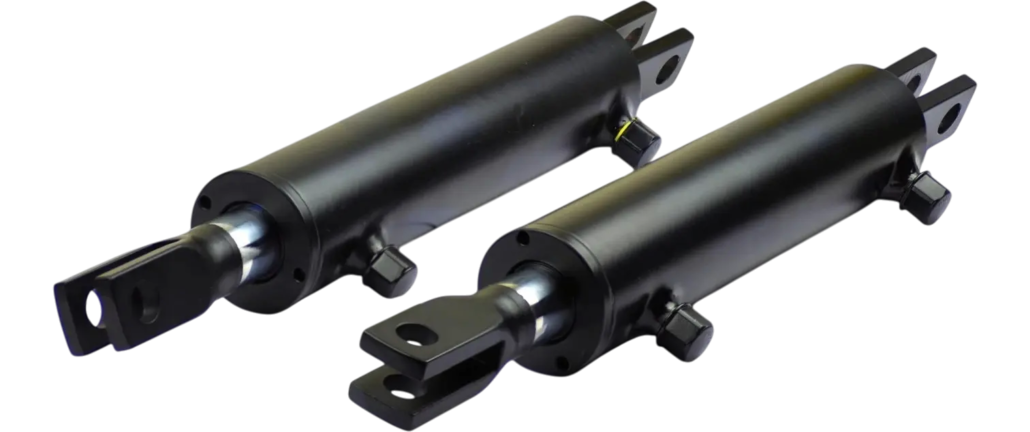
We build cylinders across forestry hydraulics, each matched to its application.
- Harvester heads: tilt, rotation and feed cylinders working alongside delimbing knives and feed rollers, under constant shock and resin contamination
- Timber cranes: boom lift, slew and telescopic extension cylinders on the main boom
- Grapple systems: log grapple cylinders closing repeatedly under off-centre, asymmetric loads
- Forwarders: bunk and load-space cylinders, plus stabiliser-leg cylinders that take the full weight of the machine on uneven ground
- Skidders and feller-bunchers: grapple and accumulator-arm cylinders under continuous heavy shock
- Forestry trailers: loader crane and tipping cylinders
- Sawmill lines: feed-table and log-deck cylinders, and cylinders for debarkers and chippers, where constant vibration and wet bark call for the same abrasion and corrosion resistance as the machines out in the forest
Hydraulic Motors
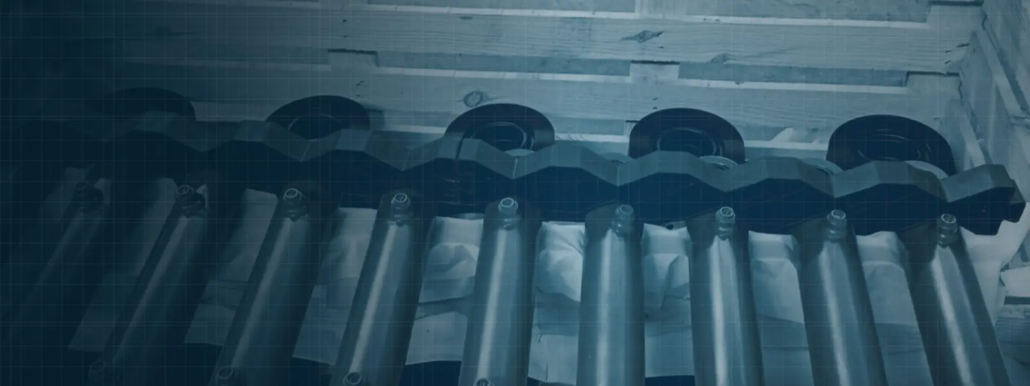
Eurobalt also manufactures hydraulic motors for the same forestry and mobile-machinery applications, on the same production floor as our cylinder range.
Quality Control
Every forestry cylinder passes the same control chain whatever its size: incoming material inspection against the mill certificate, stage checks through machining and welding, and final testing on 100% of units rather than on samples. Pressure testing runs at 1.5 to 2 times nominal working pressure. Tightness is verified on every unit, push and pull force is measured on the test stand, and results are available on request. Our FMEA database tracks warranty and field failure data across applications, and forestry duty cycles supply some of the most demanding data we collect.


